WAP MOP SHOPPE · Field Report 003
The Deep Towel
Why Does Your Towel Smell Weird Even After You Wash It?
You shower. You are clean. You reach for a clean towel. You bury your face in it. And there it is. The smell.
Not dirty exactly.
Not wet exactly.
Something older. Something established.
Your towel has developed a history.
This can be particularly confusing because you washed the thing. Detergent was involved. There may have been hot water. The machine beeped. You personally transferred the towel from one expensive appliance to another.
A process occurred.
And yet your towel smells like the basement of a lake house nobody has opened since October.
What happened?
The Institute opened an investigation.
Go Deep Into the Towel
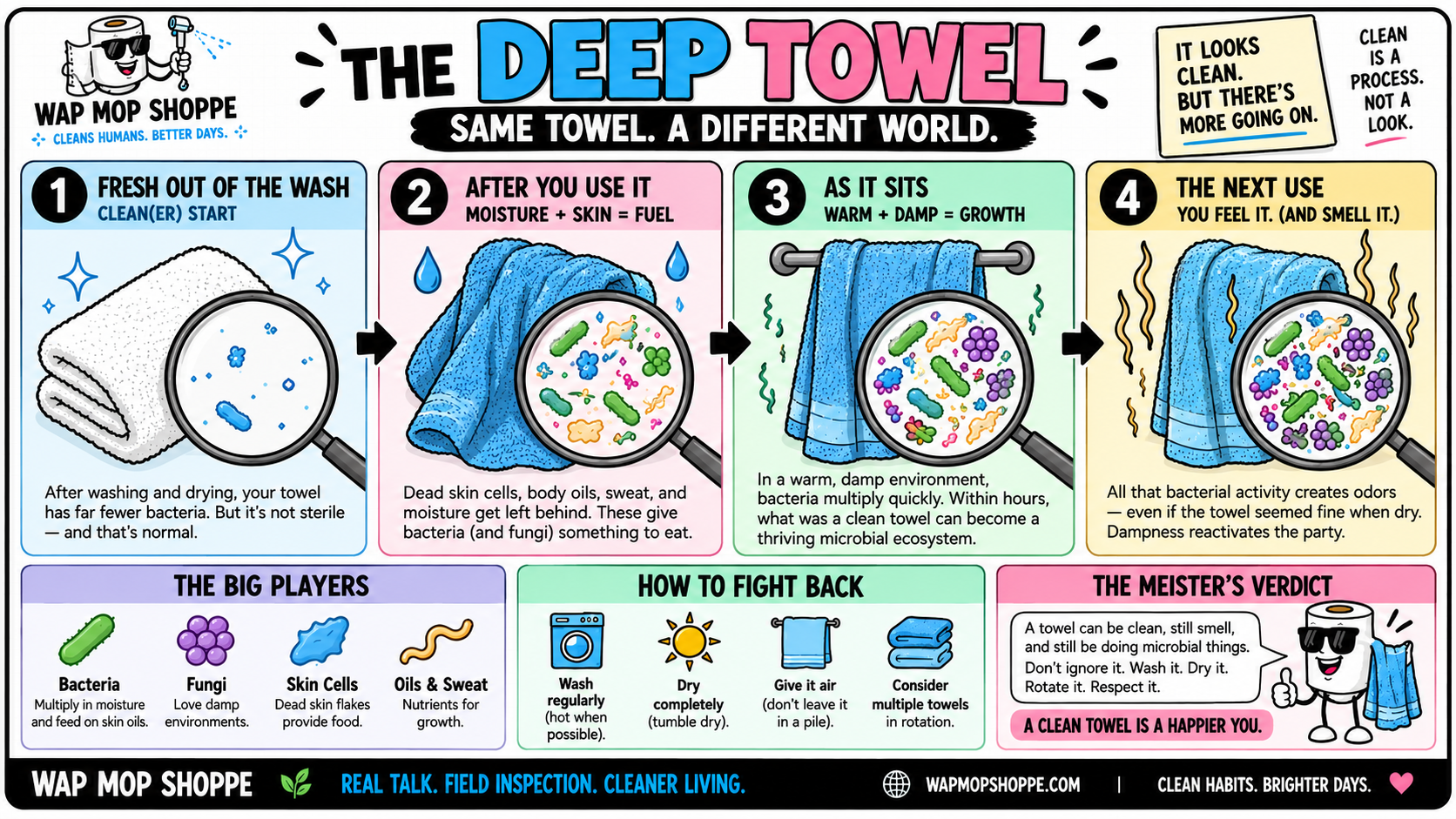
Moisture. Dead skin. Body oils. Detergent residue. Bacteria. Fungi. Drying time. We descend into the fibers to investigate what happens between “freshly washed” and “what in God's name is that smell?”
FINDING 01 — Towels have an unusually difficult job.
Consider the working conditions.
A bath towel is expected to absorb a significant amount of water from your body, along with skin cells, body oils and whatever else remains after bathing.
Then you hang it up.
Hopefully.
The towel now needs to release all that moisture into the surrounding air before you use it again.
If it dries quickly, excellent.
If it stays damp?
We have conditions.
Warmth. Moisture. Organic material. Time.
Microorganisms have reviewed this arrangement and found the accommodations satisfactory.
That doesn't mean your towel immediately becomes dangerous. Microbes are everywhere, including on normal skin and household fabrics.
But it does explain why a damp towel can begin smelling surprisingly quickly.
The towel isn't merely a towel anymore.
It's an environment.
FINDING 02 — The smell is usually not the towel itself.
Cotton has very little ambition.
Left alone, it generally does not decide to smell like a locker room.
The odor usually comes from compounds associated with microorganisms, body oils, soils, and residues remaining in or on the fibers.
Moisture allows bacteria and fungi already present on the towel to persist and grow.
And here's the important part:
A towel doesn't have to look dirty to contain all of this.
Fabric is three-dimensional.
What you see is the surface.
What laundry has to clean is everything woven into it.
The Institute refers to this as:
The Deep Towel.
FINDING 03 — Washing something and getting something clean are not always the same event.
Laundry seems wonderfully binary.
Dirty clothes go in.
Clean clothes come out.
But washing machines are systems.
Their performance depends on water, detergent, agitation, temperature, load size, rinse performance and drying.
Change enough variables and the outcome changes.
One common mistake is packing the machine too tightly.
Your washing machine is not a suitcase.
Clothes and towels need room to move so water and detergent can circulate through them.
If you've packed twelve towels into a washer with the density of a neutron star, detergent is not going to negotiate its way evenly through the load.
The machine may finish.
The towels may be wet.
Neither fact proves they are clean.
FINDING 04 — More detergent can make things worse.
This feels unfair.
Towel smells dirty.
Detergent cleans towels.
Therefore:
More detergent = more clean.
Reasonable.
Potentially wrong.
Using excessive detergent can make rinsing more difficult and leave residues behind in fabric. That residue can trap soils and contribute to towels feeling stiff, coated or less fresh.
Modern detergents are concentrated.
The correct amount may be considerably smaller than the ceremonial chalice of blue liquid you remember from childhood.
Follow the detergent manufacturer's dosing guidance and account for your machine, load size, water hardness and soil level.
Do not simply keep pouring until the ancestors tell you to stop.
FINDING 05 — Fabric softener and towels have a complicated relationship.
Fabric softener has an excellent résumé.
It makes fabrics feel softer.
It can reduce static.
It can add fragrance.
Towels, however, have a specific professional responsibility:
Absorb water.
Many conventional liquid fabric softeners work by depositing lubricating compounds onto fibers. Over time, those coatings can reduce a towel's absorbency.
Dryer sheets can leave similar conditioning residues.
This doesn't mean one accidental encounter with fabric softener destroys a towel.
The towel will survive.
But regularly coating highly absorbent fabric with substances designed to alter its surface is worth reconsidering.
The Institute's position:
If the primary job is absorbing water, perhaps don't repeatedly make the fibers worse at absorbing water.
FINDING 06 — The dryer cannot fix an incomplete wash.
Here is an important distinction.
A dryer removes moisture.
It is not a time machine.
If odor-producing material remains in the towel after washing, drying may temporarily make the problem less noticeable.
Then you use the towel.
Water returns.
Warmth returns.
And the smell rises from the dead.
This is why some towels smell perfectly acceptable when they come out of the dryer but become funky almost immediately after getting wet.
The odor problem wasn't necessarily created during that shower.
You reactivated it.
The Institute recognizes that this sounds ominous.
We stand by the wording.
INCIDENT REPORT — The towel that spent six hours in the washer.
We have all done this.
The machine finishes.
You intend to move the laundry.
Then life happens.
Dinner.
Work.
Children.
Television.
A remarkably compelling internet investigation into whether
a celebrity has secretly had hair plugs.
Several hours later:
The towels remain inside the closed washing machine.
Wet.
Warm.
Together.
This is not ideal.
If laundry develops a musty smell while sitting wet in the washer, simply drying it may preserve the problem.
Wash it again.
Then dry it promptly and thoroughly.
The Institute recommends setting a timer if you are the sort of person who routinely forgets laundry exists the moment the machine stops making noise.
We are familiar with this condition.
FINDING 07 — Your towel hook may be an accomplice.
Look at how your towel hangs.
Is it spread out?
Or has it been folded over itself into a dense damp wad?
Airflow matters.
A towel bar allows a towel to spread out.
A large hook can work if the towel hangs relatively open.
A tiny hook that compresses the entire towel into one moist fist?
Less ideal.
The faster the towel dries, the less time moisture-loving organisms have to enjoy themselves.
This becomes especially important in humid bathrooms.
If your bathroom stays damp after showers, ventilation matters too.
Run the exhaust fan.
Open the door when appropriate.
Let the room dry.
Your towel is trying to accomplish something.
Give it a chance.
THE QUESTION EVERY HOUSEHOLD EVENTUALLY ASKS — How often should you wash bath towels?
There is no universal countdown clock at which a towel suddenly becomes filthy.
How often you need to wash it depends on how quickly it dries, how it's stored, who is using it, humidity, skin conditions and other circumstances.
But a commonly recommended rule of thumb is to wash a bath towel after roughly three uses, particularly if it isn't drying completely between uses.
If a towel smells?
Wash it.
If it remains damp for long periods?
Wash it more frequently.
If multiple people are sharing it?
First:
Why?
Second:
Wash it.
Personal towels should generally remain personal.
This is not a communal hand towel at the county library.
FIELD PROCEDURE — How to rehabilitate a funky towel
Step 1: Wash it properly.
Use an appropriate amount of quality detergent. Do not overload the machine. Use the warmest water permitted by the towel's care label and appropriate for the detergent you're using.
Step 2: Skip the fabric softener.
At least while troubleshooting. Let the towel return to its natural profession.
Step 3: Consider oxygen bleach when appropriate.
For washable towels whose care labels allow it, an oxygen-based bleach can help remove stains and soils. Follow the product directions. Do not improvise laundry chemistry.
Step 4: Dry completely.
Not mostly.
Not "probably."
Completely.
Step 5: Smell the towel when it gets damp again.
This is the real examination. If the smell immediately returns after the next shower, residues may still remain. Repeat the cleaning process if appropriate.
A NOTE ABOUT VINEGAR
The internet loves vinegar.
Vinegar cleans windows.
Vinegar removes scale.
Vinegar appears in salad dressing.
Therefore, according to the internet, vinegar can apparently repair everything from laundry to relationships.
White vinegar is sometimes used in laundry to help address odors and residues.
However, appliance manufacturers may caution against frequent or improper use because acids can affect certain rubber components over time.
So before pouring vinegar into your washing machine because a lifestyle website told you to:
Check the machine manufacturer's instructions.
The Institute supports experimentation.
The Institute also supports warranties.
A NOTE ABOUT BAKING SODA
Baking soda has also entered the laundry mythology.
It can help neutralize certain odors and alter wash-water chemistry.
But again:
It is not magic dust.
Do not begin randomly combining vinegar, baking soda, bleach, detergent and whatever else lives beneath your kitchen sink.
Cleaning products are chemicals.
Some combinations can be ineffective.
Others can be dangerous.
Especially important:
Never mix chlorine bleach with vinegar or other acids.
That can release toxic chlorine gas.
Your towel is not worth creating a chemical emergency.
If you're using a laundry additive, follow its label.
One problem at a time.
FINDING 08 — Sometimes the washing machine is the thing that smells.
This is an unpleasant development in the investigation.
If multiple loads of supposedly clean laundry emerge smelling musty, inspect the machine.
Front-loading washers in particular can retain moisture around door gaskets, detergent dispensers and other areas.
Residue can accumulate.
Microbial growth can occur.
Then every load takes a little field trip through the problem.
Follow your washing machine manufacturer's cleaning instructions.
This may include:
- Cleaning the gasket.
- Cleaning detergent dispensers.
- Running a designated washer-cleaning cycle.
- Leaving the door open between loads when the manufacturer recommends it.
And occasionally confronting whatever has been living beneath the detergent drawer.
Bring courage.
EQUIPMENT INSPECTION — What actually helps towels stay fresh?
A decent towel bar
More useful than an elaborate bathroom accessory if it allows the towel to dry properly.
A working exhaust fan
Humidity management is part of towel management. Bodies are systems. Bathrooms are also systems.
Appropriate detergent
Enough.
Not all of it.
Oxygen-based laundry booster
Potentially useful for stubborn washable loads when permitted by care instructions.
A washing-machine cleaner
Useful when the machine itself needs maintenance.
Extra towels
Perhaps the most sophisticated solution.
If a towel isn't dry yet, use another towel.
The Institute occasionally reaches conclusions of staggering complexity.
WHEN SHOULD YOU THROW A TOWEL AWAY?
Eventually, towels retire.
Fibers wear.
Edges fray.
Absorbency declines.
Odors can become difficult to remove.
But smell alone doesn't necessarily mean a towel is finished.
If proper washing restores it and it dries well, carry on.
If you've repeatedly cleaned it appropriately and it still smells immediately after becoming damp, you may decide its active bath service has ended.
That does not necessarily mean landfill.
Old towels can become:
- Cleaning rags.
- Pet towels.
- Garage towels.
- Spill towels.
- Emergency towels.
The towel has not failed.
It has been reassigned.
SYSTEM NOTE — Laundry is intimate care.
We tend to separate laundry from personal hygiene.
One happens in the bathroom.
The other happens in a machine.
But towels touch your skin.
Sheets touch your skin.
Underwear touches your skin.
Washcloths touch your skin.
Clothing holds sweat, oils, microorganisms and whatever the outside world contributed that day.
Laundry is therefore not merely housekeeping.
It's part of the system.
And like most systems, the boring parts matter:
Enough detergent.
Enough water.
Enough movement.
Enough rinsing.
Enough drying.
No mystical laundry rituals required.
THE MEISTER'S VERDICT
Why does your clean towel smell weird?
Usually because something in the wash-dry-use cycle isn't quite working.
The towel may not be getting fully clean. It may contain detergent or softener residue. It may be sitting wet too long. It may not be drying completely between uses. Or the washing machine itself may need attention.
The solution is rarely:
Make the towel smell more like lavender.
Fragrance can cover odor. It cannot negotiate with the underlying cause.
Start with the basics.
Wash properly.
Use reasonable detergent.
Skip softener while troubleshooting.
Dry completely.
Hang the towel so air can reach it.
And if the towel continues smelling like an abandoned summer camp every time it gets wet?
Thank it for its service.
Reassign it to the garage.
— The Meister
WAP MOP SHOPPE · Equipment Locker
Towel Rehabilitation Equipment
The investigation suggests that towel rehabilitation is mostly a matter of cleaning properly, drying completely and giving moisture somewhere to go. The Equipment Locker contains a few items worth inspecting for the assignment.
Quick-Drying Towels
A towel needs to absorb water and then successfully stop being wet. Absorbency, drying speed and durability all matter.
Inspect the Towels →Laundry Detergent
Quality detergent used at an appropriate dose. The Equipment Locker does not endorse the ceremonial chalice method.
Inspect the Detergent →Drying Rack
Not technologically impressive. Extremely good at providing wet fabric with surface area and airflow.
Inspect the Drying Rack →Dryer Balls
A simple way to help separate laundry in the dryer without repeatedly coating towels with conventional fabric softener.
Inspect the Dryer Balls →Still on the Institute's inspection list
- Oxygen-based laundry boosters
- Fragrance-free detergents
- Washer-cleaning tablets
- Towel bars
- Turkish towels
- Microfiber travel towels
- Breathable laundry bags
Evaluation criteria: Cleaning / Drying Speed / Residue / Durability / Value / Ease of Use
No product earns points simply for making laundry smell like an Alpine meadow. The Institute has been to meadows. Towels do not naturally smell like that.
Affiliate disclosure: Some links in the Equipment Locker are affiliate links. WAP MOP SHOPPE may earn a commission from qualifying purchases at no additional cost to you.